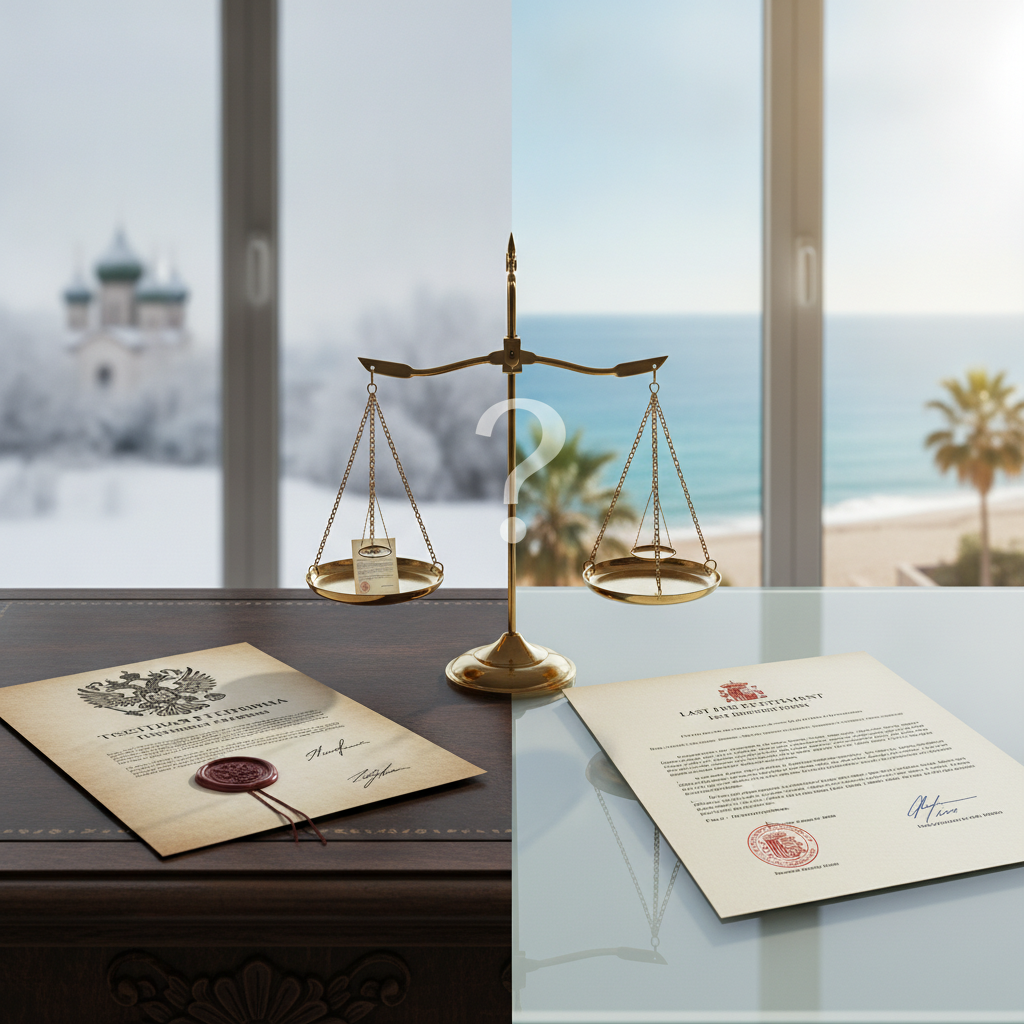
For many expatriates living on the sun-drenched shores of the Costa del Sol, the complexities of international law often take a backseat to enjoying the Mediterranean lifestyle. However, for those who have established a life in Spain, whether as a retiree or a business professional, one critical question eventually arises: what happens to my assets when I am gone? As a legal professional specializing in cross-border law for the Russian-speaking community and international clients in Spain, I, Victoria Malkova, frequently encounter a specific concern: Will in the Country of Origin vs. Will in Spain: Which is Valid?
The Legal Framework: European Succession Regulation
To understand the validity of a testament, we must first look at the European Union's legal landscape. Since August 17, 2015, the European Succession Regulation (EU No. 650/2012), also known as "Brussels IV," has governed inheritance matters across most EU member states, including Spain. This regulation was designed to simplify the inheritance process for citizens who own property or reside in a country other than their country of origin.
Under this regulation, the default law applicable to the entire succession of a deceased person is the law of the country in which they had their "habitual residence" at the time of death. This means if you are a Russian citizen living permanently in Marbella, Spanish law would technically apply to your global estate unless you have explicitly stated otherwise in a valid will. This is the first step in understanding the tension between a will made in your home country and one made in Spain.
Is a Foreign Will Valid in Spain?
The short answer is yes, a foreign will is generally recognized as valid in Spain, provided it meets certain international standards. Spain is a signatory to the Hague Convention on the Form of Testamentary Dispositions. This means that if a will was executed legally according to the laws of the country where it was signed, or according to the laws of the testator’s nationality, Spain must recognize its formal validity.
However, "validity" does not always equate to "efficiency." If you rely solely on a will executed in Russia or another country of origin, your heirs will face a daunting bureaucratic mountain. The foreign document must be translated into Spanish by a sworn translator and must carry the Hague Apostille to verify its authenticity. Furthermore, a "Grant of Probate" or an equivalent document from the country of origin must be obtained to prove who the legal heirs are. This process is time-consuming, expensive, and can delay the distribution of assets for months or even years.
The Advantages of Having a Spanish Will
While your foreign will might be legally valid, I always advise my clients in the Costa del Sol to draft a specific Spanish will to cover their assets located within Spanish territory. This does not necessarily revoke your foreign will; rather, it complements it. This is often referred to as a "double will" strategy.
A Spanish will, signed before a Spanish Notary, offers several immediate benefits. Firstly, it is written in Spanish (or a bilingual format), meaning no expensive sworn translations are required after your passing. Secondly, the Notary automatically notifies the Central Registry of Wills (Registro Central de Últimas Voluntades) in Madrid. When a person dies in Spain, the first thing the lawyers do is request a certificate from this registry to see if a will exists. If it does, the process becomes significantly smoother.
Furthermore, a Spanish will allows you to explicitly choose the law of your nationality to govern your succession. For many Russian expats, this is crucial. Spanish law includes "forced heirship" rules, which dictate that a certain percentage of your estate must go to your children or spouse, regardless of your wishes. By opting for your national law in a Spanish will, you can often bypass these restrictions and ensure your assets are distributed exactly as you intended.
Will in the Country of Origin vs. Will in Spain: The Conflict
When discussing "Will in the Country of Origin vs. Will in Spain: Which is Valid?", we must consider the risk of contradiction. If you have a will in Russia that says "I leave all my global assets to Person A," and a later will in Spain that says "I leave my Spanish villa to Person B," legal conflicts can arise. In Spain, the most recent will generally takes precedence regarding the assets it covers.
To avoid these conflicts, it is essential that both documents are drafted with "compatibility clauses." Your Russian will should explicitly state that it excludes your Spanish assets, and your Spanish will should state that it only applies to your assets in Spain. As a lawyer based in the Costa del Sol, I work closely with my clients to ensure that these two legal instruments work in harmony rather than in opposition.
Practical Considerations for the Costa del Sol Expat
Living in areas like Marbella, Estepona, or Sotogrande involves unique financial structures. Many expats own property through holding companies or have complex tax residencies. A Spanish will is not just a document for the distribution of property; it is a vital tool for tax planning. Inheritance tax in Andalusia has seen significant reductions and exemptions in recent years for close family members, but to take full advantage of these, the probate process must be handled correctly and within strict deadlines.
Relying on a foreign will often leads to missing these tax deadlines, resulting in heavy penalties. By having a localized will, your executor or heirs can act immediately, ensuring that the necessary tax returns are filed and the assets are protected.
Conclusion: Choosing the Right Path
In the debate of Will in the Country of Origin vs. Will in Spain: Which is Valid?, the answer is that while both can be valid, the Spanish will is the superior instrument for managing Spanish assets. It provides clarity, reduces costs for your loved ones, and ensures that your testamentary wishes are respected without the interference of complex international bureaucracy.
Navigating the intersection of Russian and Spanish law requires specialized expertise. If you own property in the Costa del Sol and want to ensure your estate is handled with the utmost care and legal precision, I invite you to coordinate a consultation. Securing your legacy today prevents the legal headaches of tomorrow.
Victoria Malkova
Legal Consultant - Costa del Sol, Spain